
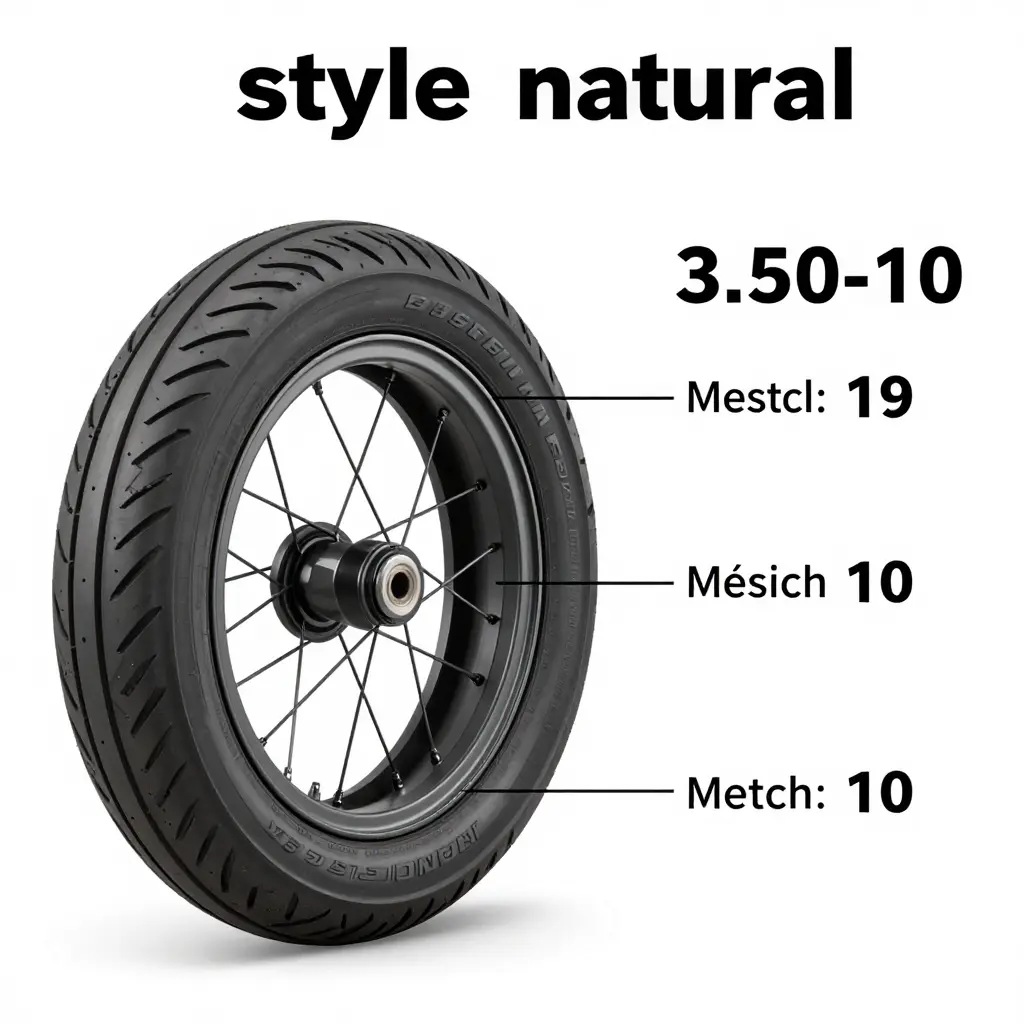
What 3.50-10 Actually Means
The 3.50-10 scooter tire uses an inch-based size code, an older format that predates metric sizing and still turns up on 50cc to 150cc scooters, mopeds and classic Vespas. Unlike a metric code, it lists only two numbers: section width and rim diameter.
- 3.50 – Section width. The cross-section measures 3.50 inches (about 89 mm) at its widest point on a mounted, inflated tire.
- 10 – Rim diameter. The tire fits a 10-inch wheel measured bead seat to bead seat. The 10 describes the wheel, not the tire’s height.
- No aspect ratio shown. This older format leaves sidewall height implicit in the width rather than stating it as a separate figure. A metric tire puts it in the middle number.
How it differs from metric sizing
A metric equivalent such as 100/90-10 reads as a 100 mm section width, an aspect ratio of 90 percent (sidewall height equals 90 percent of the width), and the same 10-inch rim. Because the metric code carries more information, the two systems never map to each other one-to-one. This inch-to-metric conversion reference works through a comparison of the two codes.
Why width drives load and pressure
Section width sets how much air volume and load area the tire has to work with. A wider 3.50-inch tire carries more load per psi than a narrow one, so it needs less pressure for the same weight. Width also has to match your rim width: squeeze a tire onto a rim that is too narrow and it bulges, flexes more, and demands higher pressure to stay stable. Check the approved rim range, weigh your load, and set PSI from those numbers instead of from a generic sticker.
The schematic below shows the rim-width principle at a glance. On the left, a narrow rim pulls the same 3.50-10 tire’s sidewalls inward, so the carcass bulges outward and the tread crowns into a rounder, taller profile. On the right, a wide rim holds those sidewalls more vertical, flattening the tread and widening the contact patch. One tire, two very different shapes, and two different air volumes, load capacities and ideal pressures.
That geometry is exactly why a single “recommended PSI” for a 3.50-10 rarely fits every scooter. A flatter profile on a wide rim tolerates lower pressure before it squirms under load, while the rounder profile on a narrow rim needs a touch more air to resist sidewall roll in corners. For the practical numbers that follow from this, see our guide to maximizing safety on 3.50-10 scooter tires.
Load: The Second Variable in Your PSI Decision
Once rim width sets the base geometry, load decides how much air the tire actually needs to carry. Every pound placed on a 3.50-10 scooter tire is held up by the air column inside it, so total vehicle weight is the starting figure for any scooter tire PSI calculation.
What Counts as Load
Start with the scooter’s curb weight, then add everything the tire has to carry:
- Rider weight – the largest single variable on most 50cc-150cc machines.
- Passenger weight – a second rider can nearly double rear-axle load, which is why rear PSI specs sit higher than front.
- Cargo – top boxes, panniers, groceries or tools shift load onto one axle and change the front-to-rear balance.
- Weight distribution – a rear-biased scooter pushes more load to the rear tire, so the two tires rarely need identical pressure.
Load and Pressure Move Together
The relationship is direct: as load rises, required pressure rises with it, up to the tire’s maximum rating printed on the sidewall. A lightly loaded 3.50-10 tire might run comfortably at the low end of its range, while the same tire carrying a passenger and luggage needs several more PSI to keep the contact patch stable. Pressure is what resists sidewall deflection, so more load calls for more internal support to hold the same shape.
The Cost of Ignoring It
Under-inflate for the load and the sidewall flexes excessively on every rotation, generating heat that accelerates casing fatigue, uneven wear and the risk of a blowout. Over-inflate and the tire loses compliance, producing a harsh ride, reduced grip and center-strip wear. Both errors shorten tire life and compromise handling.
You can follow the full load-to-pressure method here: how load and rim width set your scooter tire PSI.
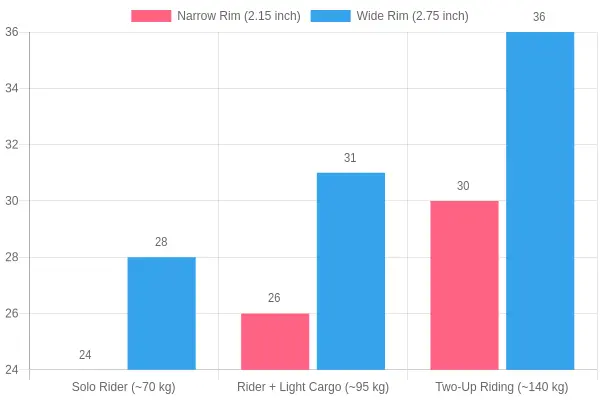
As load climbs, so does the recommended PSI – from roughly 24-28 PSI for a solo rider to about 30-36 PSI for two-up riding. Rim width shifts that target again: a wide 2.75-inch rim calls for a few extra PSI at every load level compared with a narrow 2.15-inch rim. For a full walkthrough of matching rim, load and pressure, see our guide on how to maximize safety with 3.50-10 scooter tires.
Setting Your Real PSI: A Step-by-Step Method
- Check cold pressure first. Measure the tire before any riding, while it still sits at ambient temperature. Heat from a ride raises the reading and can temporarily mask an underinflated tire.
- Identify your tire size and rim width. Confirm the sidewall marking (for example, 3.50-10) and measure the actual rim width, since the same tire demands different pressure on a narrow rim than on a wide one.
- Account for the actual load. Add rider weight, luggage and any accessories, then compare the total against the tire’s load rating to see the real demand placed on the carcass.
- Apply the recommended baseline. Start from a manufacturer or calculator baseline specific to your 3.50-10 scooter tire pressure, not from a generic number intended for a different size or load.
- Adjust in small increments. Change pressure by 1-2 PSI at a time and test each setting on the same route, so you isolate one variable rather than several.
- Re-verify. Recheck the pressure once the tire has cooled, record the final value, and confirm the setting still matches your target.
Adjusting in small increments is safer than large jumps because each 1-2 PSI change produces a measurable, predictable shift in contact patch size and sidewall flex. A big leap can overshoot the optimal zone entirely, pushing you from stable grip straight into vague steering, overheating or a sudden loss of traction, with no data to show which direction you went wrong. Incremental testing keeps every step reversible and traceable. For a closer look at safe operating limits, see this guide to maximizing safety on 3.50-10 scooter tires.
Recommended 3.50-10 Scooter Tire PSI by Rim Width and Load
Use the quick-lookup reference below to set a starting scooter tire PSI for a 3.50-10 tire. The values assume a typical 50cc-150cc scooter running street tires on pavement, and they shift with both rim width and how much weight the bike is carrying.
| Rim Width | Load Condition | Front Tire PSI | Rear Tire PSI |
|---|---|---|---|
| Narrow (2.15″) | Solo rider | 22 | 26 |
| Narrow (2.15″) | Rider plus cargo | 24 | 30 |
| Standard (2.50″) | Solo rider | 24 | 28 |
| Standard (2.50″) | Rider plus cargo | 26 | 32 |
| Wide (2.75″) | Solo rider | 26 | 30 |
| Wide (2.75″) | Rider plus cargo | 28 | 34 |
Footnote: These figures are starting points only. Always verify them against the PSI stamped on the tire sidewall and the pressures listed in your scooter’s owner manual.
Two things move these numbers. As load increases from solo riding to rider-plus-cargo, both tires need more air to support the extra weight without squashing the sidewall. A wider rim also demands slightly higher PSI, because the same tire volume spreads a larger contact patch that benefits from added stiffness to keep the handling sharp. For a deeper walkthrough of balancing pressure, wear and grip on this exact size, see how to maximize safety on 3.50-10 scooter tires.
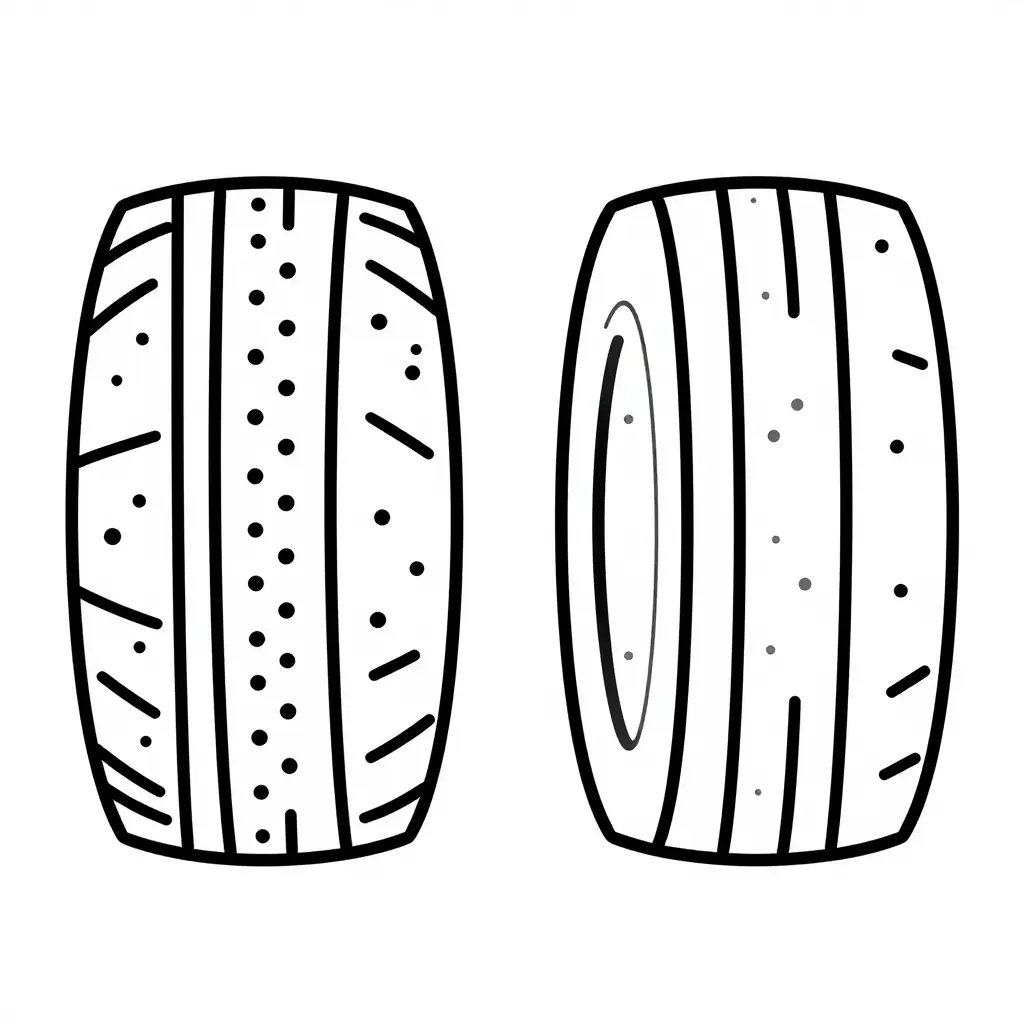
The schematic above captures a simple idea that matters a lot on a scooter: the same sealed tire-air volume behaves differently once heat enters the picture. On the left, tightly packed dots represent a cold tire, with cooler air, lower pressure and a more compressed volume. On the right, looser, lighter dots represent the same tire after a few miles of riding, when friction and ambient heat raise the temperature, expand the gas and push pressure higher.
No gauges, no numbers, just the visual relationship. Keep that mental picture with you, because the cold-versus-hot gap is exactly why you should always set PSI on a stone-cold tire and then estimate the warm reading rather than the other way around.
Using the Tire Pressure Calculator for Your Setup
Getting your 3.50-10 scooter tire pressure right is not about guessing a round number off the sidewall. It is about matching your real setup – your rim width, your load, your riding style – to a pressure that keeps the contact patch consistent. An online tire pressure calculator does that math for you in seconds.
The 3.50-10 label tells you only that the tire is 3.5 inches wide and fits a 10-inch rim. It says nothing about the ideal PSI, which depends on how the tire sits on your specific wheel and how much weight it carries.
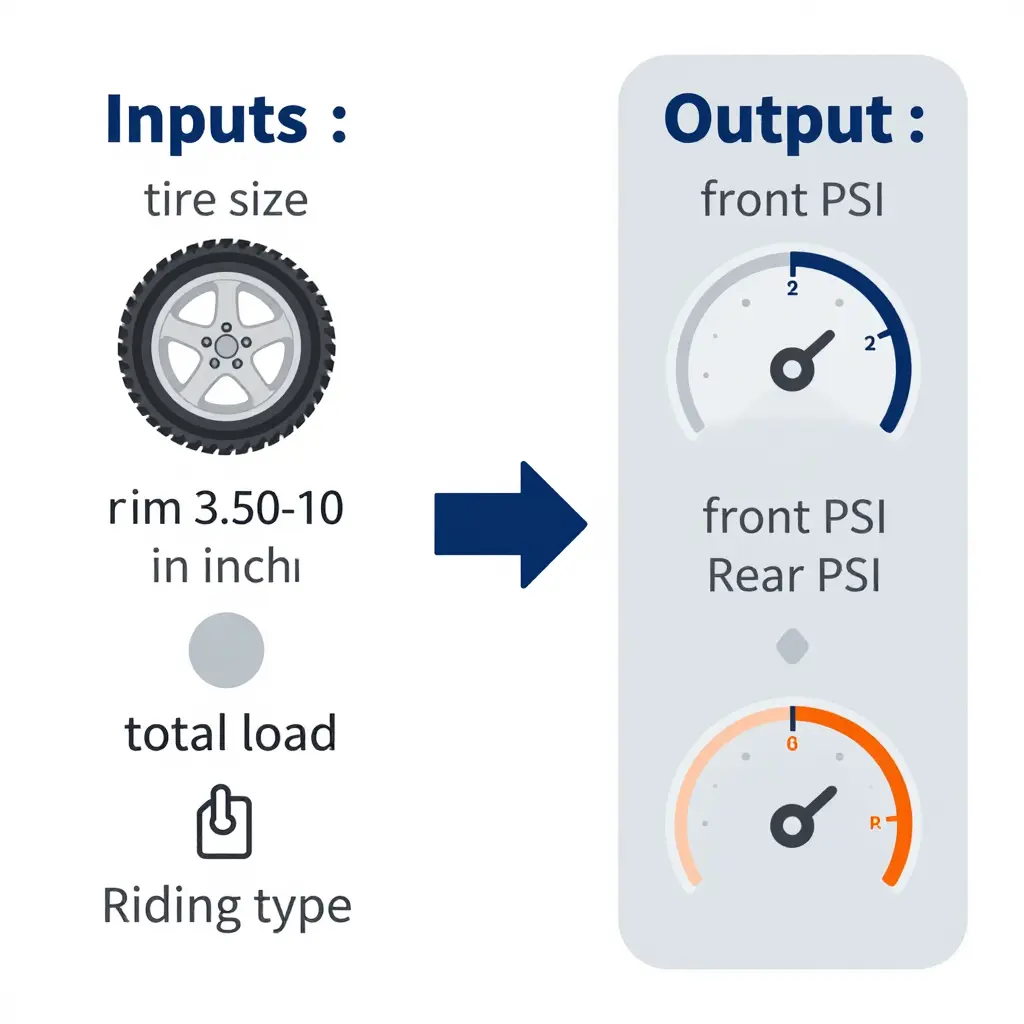
What Inputs Actually Matter
To get a useful number, the calculator needs a few honest inputs:
- Tire size: enter 3.50-10 so the tool knows the baseline width and rim diameter.
- Rim width: measure the actual bead width in inches, not the tire width.
- Load: the combined weight of rider, gear and the scooter on that wheel.
- Use case: commuting, sport riding or rough surfaces shift the target range.
How to Read the Output
The calculator typically returns a PSI range for the front and rear tire, not one rigid number. Treat that range as your working window. A wider rim needs slightly less pressure for the same load, while a heavier rider or a narrow rim pushes the target upward. Start at the midpoint, then fine-tune based on how the scooter feels and how the tread wears.
3 Quick Tips for Accurate Inputs
- Measure rim width with calipers instead of trusting a manual that may cover a different model year.
- Weigh the real load on each wheel rather than estimating from the scooter’s dry weight.
- Change pressure in small 1-2 PSI steps and test ride before locking in your setting.
Feed in clean numbers and the calculator turns a vague sidewall spec into a pressure you can actually trust.
Frequently Asked Questions
What is the correct PSI for a 3.50-10 scooter tire?
There is no single universal number, but most cold 3.50-10 scooter tire pressure settings land between 25 and 30 PSI (roughly 1.7 to 2.1 bar) on a stock rim carrying one average rider. That figure shifts the moment rim width or cargo load changes, so treat it as a starting baseline rather than a fixed rule. Confirm the placard value in your owner’s manual first, then fine-tune from there.
Should front and rear tire pressures differ on a 3.50-10 scooter?
Yes, and they usually should. The rear tire carries most of the rider and drivetrain load, so it typically runs 2 to 4 PSI higher than the front, which needs a slightly softer setting for steering grip and a larger contact patch. That front/rear split is a load decision more than a style preference.
How does rim width change the recommended scooter tire PSI?
Rim width changes how the casing is supported. A 3.50-10 tire on a narrow 2.15-inch rim bulges into an oval profile and needs more pressure to resist squirm; on a wider 2.75 or 3.00-inch rim the tread sits flatter and can support the same load with less air. Run your own specs through this tire pressure calculator to see how each rim-width change moves your target.
Should I bleed air from a hot tire to hit the target PSI?
No. The 2 to 4 PSI rise you see on a hot tire is normal thermal expansion, not overinflation. If you bleed a hot 3.50-10 scooter tire pressure down to the cold target, you will be underinflated once it cools, risking heat build-up and sidewall damage. Always set scooter tire PSI cold.
How does load affect the required PSI for a 3.50-10 scooter tire?
Load is the biggest single variable. Heavier rider weight, a passenger or added cargo all demand higher pressure to keep the casing from deflecting too far and overheating. A lightly loaded scooter may run near 25 PSI, while a heavily loaded one can need 32 PSI or more in the rear, which is why weight should drive your final setting.